

We’re putting every major low-slope roof type in the ring tonight. Time to place your bets!
If you own one building, the betting is relatively straightforward. The climate zone, budget, and project goals likely point to a favorite.
If you’re managing 10 or 100 roofs across an institutional portfolio, deciding where to place your money gets a lot trickier. The financier likes one contender; maintenance and warranties like another; and the facilities team wants to pool the money on the same fighter every round for familiarity. With that many hands on the betting slip, there’s no such thing as a sure thing.
The Scoring
Before anyone steps in the ring, some ground rules. Every fighter gets judged on the same stats:
| Stat | What It’s Judging |
|---|---|
| Labor Availability | Who’s actually around in your market to get this fighter in shape? |
| Cost | What does it take to get this fighter in the ring in the first place? |
| Puncture & Impact Resistance | Can it take a hit (hail, foot traffic, dropped tools) without going down? |
| Chemical & Grease Resistance | What range of attacks can it handle; hits only or can it also take jeering and thrown concession drinks? |
| Ease of Repair | When it does get hurt, how hard is it to patch back up? |
| Durability / Lifespan | How long before it’s tapping out? |
The Contenders
Let’s meet the lineup! Tonight’s card has two weight classes.
In the single-ply division, where one membrane stands between your building and the weather:
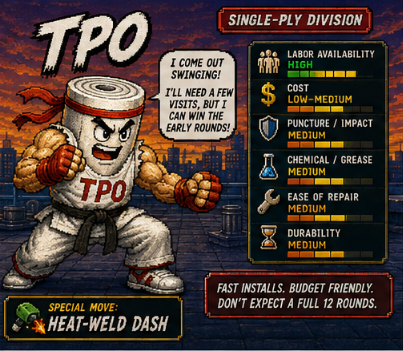
TPO
Comes out swinging, but don’t expect it to go the full 12 rounds without a handful of visits for repair.
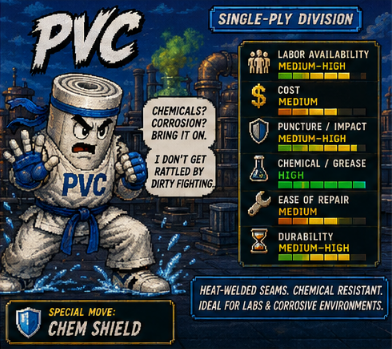
PVC
Unbothered by dirty fighting. When the rooftop’s throwing lab exhaust and corrosive venting, this is who you send into the ring.

EPDM
The budget fighter. Never flashy, but when it takes a hit, it can be patched up without much fuss.
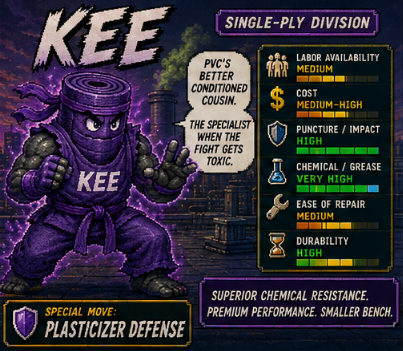
KEE
PVC’s better-conditioned cousin when it comes to dirty fighting, but good luck finding a trainer familiar with its style. If your market has the installers and your budget has the room, though, it’s a strong contender.
And in the multi-ply division, built-up from multiple redundant layers:

Modified Bitumen (SBS/APP)
The brawler. Not pretty, but it can take a punch and stay standing till the bell rings. While older style fighters like it hot, newer fighters often prefer to play it cool.

Built-Up Roofing (BUR)
The old heavyweight with the longest record in the sport; it’s been winning fights since before some of the other fighters were born. Just know that the hot-applied version brings a kettle of molten asphalt to the fight, along with jobsite fire and safety considerations most of the modern fighters don’t carry.
The weight classes matter, because the two divisions play a different game. That layered redundancy is a big part of why Modified Bitumen and BUR score so well on durability and impact resistance. But it cuts the other way on repairs: with more layers stacked together, tracking down exactly where a leak is coming from takes more work than tracing a single membrane. The padding takes the punch — but it also hides the bruise.
Here’s how the fighters stack up before a single punch gets thrown. And please, before sending any angry emails, know that fighter stats often vary by venue.
| Fighter | Labor Availability | Cost | Puncture/Impact | Chemical/Grease | Ease of Repair | Durability |
|---|---|---|---|---|---|---|
| TPO | High | Low-Medium | Medium | Medium | Medium | Medium |
| PVC | Medium-High | Medium | Medium-High | High | Medium | Medium-High |
| EPDM | High | Low | Medium | Low-Medium | High | Medium |
| KEE | Medium | Medium-High | High | Very High | Medium | High |
| Modified Bitumen (SBS/APP) | Medium | Medium-High | High | Medium | Low-Medium | High |
| Built-Up Roofing (BUR) | Low-Medium | High | High | Medium | Low | Very High |
Choose Your Fighter
So how do you pick? Size up the fight before you pick the fighter:
- Climate zone and rooftop exposure. Sun, hail, wind, or something more corrosive — this is your durability and impact resistance test.
- Consequence of failure. A leak over a data closet is not the same emergency as a leak over storage.
- Rooftop use and equipment. Lab exhaust, solar arrays, and foot traffic all change which stat decides the fight.
- Ease of repair when something does go wrong. Single-ply systems are usually easier to diagnose than multi-ply, even though multi-ply redundancy often buys more durability up front.
- Local labor availability. The best system on paper isn’t a real win if nobody qualified is nearby to install or service it.
- How many systems you already run. Every new “optimal” system you add is one more thing your team, your budget, and your warranty tracker have to carry.
The Matchups
Stats are useful, but real jobs come down to which stat matters most for the specific condition on your roof. Here’s how the fight plays out in a few common scenarios:
| Rooftop Condition | Winner | Why |
|---|---|---|
| Laboratory or industrial facility with frequent exhaust or corrosive fume exposure | PVC or KEE | Both hold up well against chemical exposure. KEE goes the extra round when fumes are heaviest and plasticizer loss is the real long-term risk. |
| Budget-driven warehouse re-roof, or retail commercial spaces | TPO or EPDM | Best cost and install speed, with a deep, readily available labor pool. |
| Exposed rooftop in a hail-prone region | Modified Bitumen or BUR | Puncture and impact resistance send this one straight to the final. |
| High-value commercial spaces such as hospitals, data centers, etc., where downtime is not an option — or the “we’re not touching this roof for 30 years+” institutional owner | Modified Bitumen or KEE (runner up: PVC) |
Long service life through heat-welded seams or redundant multi-ply construction with strong overall system durability. |
| Solar-ready, ballasted, or heavily trafficked roofs | PVC, KEE, Modified Bitumen, or BUR | Reinforced or multi-ply construction tolerates rack penetrations and repeat maintenance traffic better than lighter single-ply options. |
The Real Winner

For One Building
There’s no undefeated champion — anticlimactic, we know. The right fighter depends on both your project and your needs. If you’re picking a system for one building, match the fighter to the fight and make sure to weigh what’s riding on the outcome.
For a Portfolio
A portfolio is where it gets more interesting, and is where a lot of portfolio managers get talked into a mistake.
If matching the “perfect” fighter to every single roof sounds like optimization, that’s because it is — at the individual roof level. But a portfolio isn’t one fight. It’s 10 or 100 fights happening across your career, and picking a different specialist champion for every single one comes with costs that don’t show up on the summarized stat card.
Consider what happens to a portfolio built entirely out of one-off “best fighter for this specific roof” decisions:
- Your bid pricing gets worse, not better. Three roofs with the same system in the same bid cycle gets you real contractor and manufacturer leverage. Eight different systems across eight buildings gets you eight small, unremarkable jobs.
- Your facilities team lacks fluency. Staff who know one or two systems cold catch problems early. Staff juggling seven different membrane chemistries and detail standards end up with surface familiarity everywhere and real expertise nowhere — so they catch fewer things, later.
- Warranty tracking turns into its own part-time job. Different manufacturers, different terms, different inspection requirements, different clocks. That complexity is a cost even when every individual roof is technically the “right” choice on paper.
- Comparing condition across your portfolio gets harder. If every roof is a different system installed by a different contractor for different “optimized” reasons, you lose the ability to score the whole portfolio consistently — and consistent, portfolio-wide condition data is what turns a pile of roof reports into a capital plan instead of a reactive scramble.
- Your project teams never build continuity. Different contractors tend to be familiar with different systems, so lessons learned on one roof rarely carry over to the next, even within the same portfolio.
These tricky punches show up in your operating budget, your training costs, and how confidently you can answer “which roof needs attention next, and why” for the whole portfolio.
That’s not an argument for using one roof system everywhere regardless of conditions. A lab exhaust stack still needs real chemical resistance, and a hail-prone climate still needs real impact resistance. It’s an argument for keeping your roster small and deliberate. Pick two or three standard systems that cover the vast majority of your buildings, and reserve the outlier system for the specific conditions that demand one. The few drops of extra performance you squeeze out of custom-picking a fighter for every single roof are rarely worth what you give up. Pick a few roof systems, a few designers, and a few contractors, and use them over and over again. Don’t optimize one project. Optimize your portfolio.
Talk to a building envelope consultant
Picking a roof system for one building is one fight. Standardizing across a portfolio is a whole different card. Tell us what you’re working with and we’ll help you build a roster that holds up.
Schedule a consultation