
Disclaimer: This article aims to summarize 90.1 so that it is easy to understand and digest, and should not be considered a comprehensive source of information. The information included herein is largely based on the 2024 MN Energy Code, and is specific only to other energy codes that have adopted ASHRAE 90.1 essentially “in full” with only minor amendments to Chapter 4 and 5.
If your day-to-day job responsibilities have anything to do with designing or building buildings in a state that recently adopted ASHRAE 90.1 with open arms, you’ve probably heard the rumors: ambitious energy code yadayadayada, something about air barriers and 3rd party verification, BEC-xyz, and some ASHRAE-smashrae thing?
Sound familiar? Sound confusing? Well you’re not alone. The people who adopted and amended the standard are confused. The people who enforce the code are confused. Designers and builders who need to comply with the code are confused. owners who have to pay for all the stuff are – you guessed it – confused.
However, you’re in luck – because now after reading 90.1 (specifically, as it applies to the MN Energy Code) over and over and over and over, we here at CopelandBEC are officially Not Confused, at least for the building envelope commissioning parts of Chapter 4 and Chapter 5.
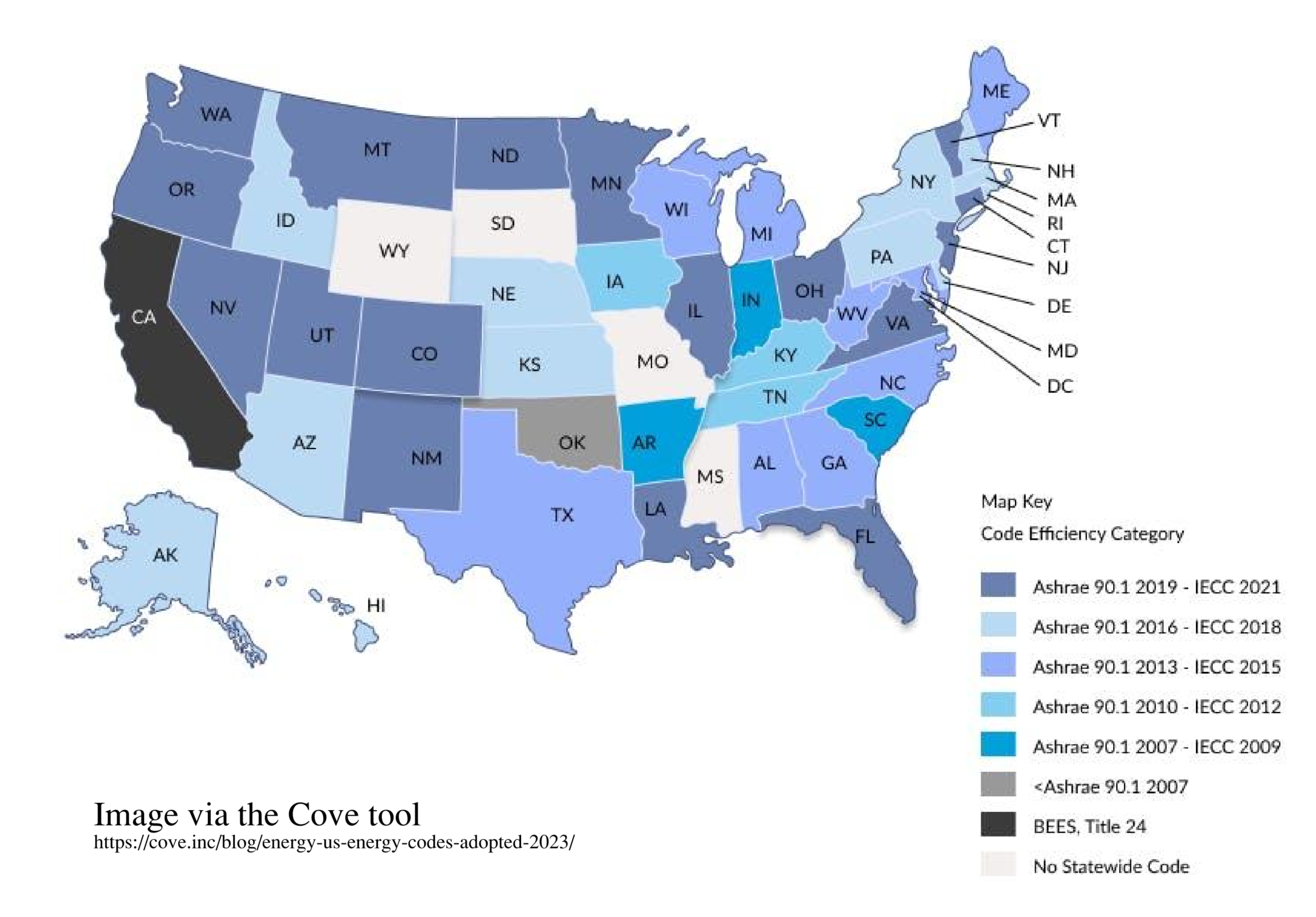
TL;DR: Yes, you do really have to do BECx*, at least if you want to comply with code and not break the law. Most projects over 10,000 square feet need to be commissioned for both the envelope and the mechanical system. Projects under 10,000 square feet (or some basic warehouses) need the envelope to be “commissioned” for the air barrier only (we like to call this BECx Lite). It probably makes the most sense to engage a 3rd party to perform these services, though there are some aspects that can technically be handled in house, for better or worse. No, functional performance testing is not the same as commissioning. “Air Barrier Verification” is also not the same thing as building envelope commissioning (though it is part of it). And lastly, to really get the best bang for your BECx buck, the process needs to be valued by the project team beyond a bare minimum code requirement or compliance checkbox. *if you’re in a State that “fully” adopted 90.1, where State-specific amendments did not slash BECx items. As far as I know, this for sure includes MN, NJ, and OR, and maybe (I’m not a national code expert, sorry) in CT, FL, ME, MD, MI, MT, NM, OH, PY, UT, VT, VA, WA, and MA if picking IECC or 90.1.
Keep reading for the whole shebang:
What is Building Envelope Commissioning?
Oh, what a can-of-worms question.But fundamentally, BECx is a process that aims to manage risk and deliver practical, systematic QA/QC for the building envelope by:
- Clearly identifying project goals and owner requirements
- Verifying that the design – aka the drawings and specifications – are in accordance with those requirements
- Verifying that the construction aligns with the design, therefore meeting project requirements
- Prepping the owner on how to maintain the building, so that the building continues to meet the project requirements
You can probably see the pattern. BECx is all about verifying that a project is meeting or will meet project requirements; i.e. that the building will work well and last long just like it’s supposed to.
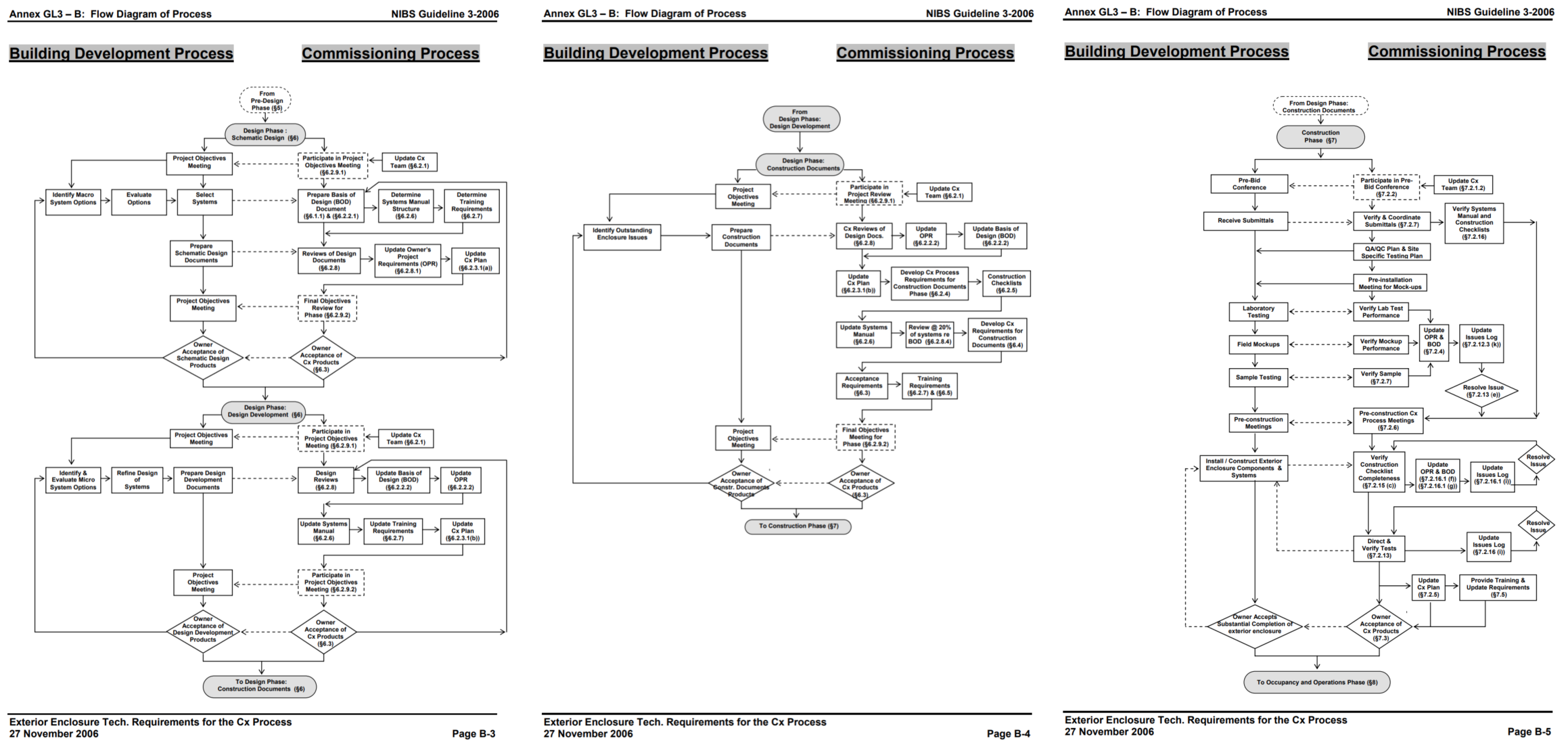
So, if code-required BECx can be distilled down into four steps a middle schooler could understand so…how hard could it really be?? Well, each of the above steps has dozens of potential phases, arrangements, and subtasks, as reflected in all standards like ASTM E2813 and E2947, ASHRAE Guidelines 0 and 202, and NIBS Guideline 3 (as shown in the GL3 snippetrs below). At a high level, a large part of any BECx scope includes some level of design review, submittal and shop drawing review, review of in progress construction, and performance testing of envelope components and/or systems. But BECx is not prescriptive, despite it being referenced in prescriptive codes (cue confusion). The exact BECx scope should be strategically refined and leveraged by someone who knows what they’re doing. While the concept is fundamentally straightforward, the approach taken can vary widely depending on the specific project size, complexity, and, frankly, how much the owner gives a damn.
What is ASHRAE 90.1?
ASHRAE Standard 90.1, officially titled Energy Standard for Buildings Except Low-Rise Residential Buildings, is a national benchmark standard that establishes minimum energy-efficiency requirements (for both the building envelope and mechanical systems) for commercial and high-rise residential construction. Developed by all the very smart people at the American Society of Heating, Refrigerating and Air-Conditioning Engineers (ASHRAE), 90.1 functions as a voluntary best-practice standard rather than an enforceable law.
On its own, Standard 90.1 carries zero zip zilch authority. It only becomes legally binding when adopted by state and local jurisdictions into their official building regulations or when model code bodies, such as the IECC, incorporate it as an equivalent compliance pathway.
Across the United States, virtually every state utilizes Standard 90.1 either through direct adoption or indirectly as an approved alternate route to the IECC. Minnesota serves as a prime example of direct adoption, utilizing the standard as the baseline for its statewide commercial regulations, with some slight state specific amendments.
What does ASHRAE 90.1 say about BECx?
BECx was soft launched in ASHRAE 90.1-2016 and more formalized in ASHRAE 90.1-2019. While the 2016 edition laid the groundwork for air barrier testing and inspection (Section 5.4.3 and 5.9.1), the 2019 edition really established commissioning expectations via Sections 4.2.5 and 5.9.2. Hang tight – more about these sections in a sec.
90.1 explicitly links commissioning requirements to ASHRAE/IES Standard 202 – “The Commissioning Process Requirements for New Buildings and New Systems”. Yes, this includes the envelope, and yes the scope goes beyond a fenestration test here or there or a little design review at the end of construction document development. Additional BECx-standards, including the relevant ASTMs and NIBS Guideline 3, are also indicated via the appendices. By referencing all of the above thousands of pages of standards, the code is specifying a thorough quality assurance process focused on building performance.
Section 4.2.5
Chapter 4 is the “paperwork section” of the code, so it largely focuses on the key BECx deliverables as the explicit code requirements and then refers to the 202 Standard to fill in the blanks for the BECx process. In application, the 4.2.5 stuff essentially means 1) every project needs a designated, qualified BECx provider, 2) the BECx provider will come up with a BECx Plan that makes sense for the project and starts in the design phase, and 3) this plan will probably include some level of design review, construction review, and performance testing (and more, if you have an outcome-oriented owner).
For code compliance documentation, you should expect to submit the following paperwork for permitting:
- BECx Plan
- A documented design review
- Construction documents reflecting commissioning requirements (largely testing information and who your commissioning providers are)
And also the following paperwork to obtain an occupancy certification:
- BECx Report
The above four items are key deliverables in the commissioning process, and would be generated during a typical BECx engagement regardless of code requirements.
Sections 5.4.3, 5.9.1, and 5.9.2
The air barrier requirements everyone seems to have tunnel visioned on are in Sections 5.4.3.1.1 and 5.9.1.2 of Chapter 5, which outlines all envelope performance requirements. These two sections really just boil down to two compliance options:
Path #1: verify the air barrier via 3rd party review of the design drawings, field inspections, and possibly air barrier material/assembly testing, throughout the project; or…
Path #2: verify the air barrier via 3rd party whole building air tightness testing at the very end.
For many projects, these two options are actually a little senseless (cue more confusion), because if you’ve engaged a BECx provider who knows anything about anything Path #1 should already be included in the core BECx process indicated by Chapter 4 – so basically any project complying with Chapter 4 is automatically eligible to skip the Path #2 blower door kit and caboodle.
However, for smaller projects under 10,000 square feet that are exempt from “full” BECx (and are therefore following what we call BECx Lite), this inclusion in the code ensures that all buildings will have some level of 3rd party QA/QC focused on building envelope energy performance. So in theory it’s worth the roundabout code pathway loops.
Which path is better? That’s worth a whole other article, but in a perfect world we’d have both. The proactive aspects of Path #1 account for the “quality assurance” piece, and the definitive, quantitative result of Path #2 account for the “quality control” piece. Both are important if we want to build good buildings.
Then comes Section 5.9.2, which is essentially just a friendly reminder saying “hey, go back to Section 4.2.5 and do that stuff.”
What DOESN’T ASHRAE 90.1 say about BECx?
Nowhere, I repeat nowhere, in ASHRAE 90.1 says “you either have to do a whole building blower door test OR do building envelope commissioning.” Not sure where this rumor came from. Lies. 90.1 also does not say “you only have to commission the air barrier, not the full envelope” — at least for projects over the 10,000 square foot threshold or nonrefrigerated warehouses — nor does it say “you can get out of all performance testing with a little sprinkle of design review and visual inspection.”
On a more pedagogical level, the code is not the right place to learn about commissioning or glean the appropriate commissioning scope for your project. That’s because it does not tell you which milestones to slate for design review, which tests to specify and perform, nor how many field visits you need. You can learn more about the BECx process by skimming the aforementioned standards, taking a training course (I will shamelessly plug the one at the University of Wisonsin–Madison, and they’re not even giving me a finders fee for saying that), or buying your friendly neighborhood envelope consultant a coffee (hint hint).
What’s in it for me?
BECx leverages specialized envelope expertise early in a project lifespan to catch errors: detailing deficiencies, incompatible product selections, unrealistic geometries, maintenance nightmares, etc. Gone unnoticed, these “tiny mishaps” can turn into costly rework or even full blown failures – whether that be a flashing configuration that works on paper but not in the field, or that the new guy on the crew butchers a key roofing transition and almost gets away with covering it up.
When buildings start leaking (air, water, or energy), the entire project team gets dragged through the mud. Not to mention, it’s an order of magnitude cheaper – and logistically, much easier – to fix something on paper than it is on an operational building. BECx manages risk for all parties by reducing the total amount of risk in the pie that’s available to be served up (rather than simply taking a slice of the pie). BECx also has a high ROI by increasing building longevity and reducing RFIs, change orders, energy inefficiencies, and dare I say – lawsuits.
Will BECx save us??!
Wonderful, the answer to all our building envelope problems is right at our fingertips – or at least, right behind the ASHRAE paywall. We can save the industry with a mere $120 pdf!!
Well… no. We really have all the information we need to build good buildings, and BECx is incredibly practical, so why are envelope defeciencies and failures seemingly lurking around every corner? Why is construction defect litigation a THRIVING industry?
This is another topic worth a whole other blog article (or several), but for BECx to really deliver on all its hypothetical glory, we need responsive project teams who want BECx providers in the room and owners who think it’s worth the cost. It’s not all about technical acumen and building science training; it’s about clear participation expectations, respecting each other’s niche and expertise, collaborating on solutions, taking the “tedious stuff” seriously, and answering emails. For god’s sake answer my emails (yes I’m talking about you).
So there you have it:
Building envelope commissioning is evolving from a “nice to have” project scope to a code minimum requirement. However, this will really only have a meaningful impact if project teams and AHJs 1) understand, apply, and enforce the code, and 2) appreciate the benefits of BECx beyond code compliance and actively participate in the process.
You gotta do it for a law abiding project. Might as well use it to your benefit to design, build, and operate better buildings.