
Disclaimer: Bid processes come in a myriad of shapes and sizes depending on the owner, the project, and how much paperwork anyone felt like doing. This post focuses on the approach where an owner puts out an RFP or drawings and specifications and the solicited vendor sends back a price to fulfill them.
In an ideal world, we compare bids apples to apples – our unicorn situation, if you will. Apples to oranges might get an eye roll out of me, but in the grand scheme of things those are still pretty mystical, in that at least both of those are fruits and fit in a lunchbox. The pattern (if we can call it that) that emerges much more often is apples to gorillas. Definitely not unicorn-shaped and a far cry from feeling mystical.
The biggest problem with the gorilla is that, as obvious as it may appear to someone who sees gorillas often, it doesn’t announce itself to those who don’t. Every bid has the same project name at the top and a cost at the bottom, so if the numbers are far apart, the temptation is to be pleased about the low one rather than suspicious of it. And look, I get it, because I love a sale too. A low number feels like a good day…right up until you find out what that low number isn’t buying you that, of course, you thought was included. You deserve to know exactly what you’re buying (yes, I'm aware you think you already do, but appease me for the next 5 minutes of reading). That starts with being able to tell a gorilla from an orange from an apple when they're sitting side by side on your desk, and it ends, if we do this right, with a bunch of apples on the next project.
Spotting the Gorilla
Your low bid is only a good deal if it's buying the same roof as your high bid. So, how can we tell?
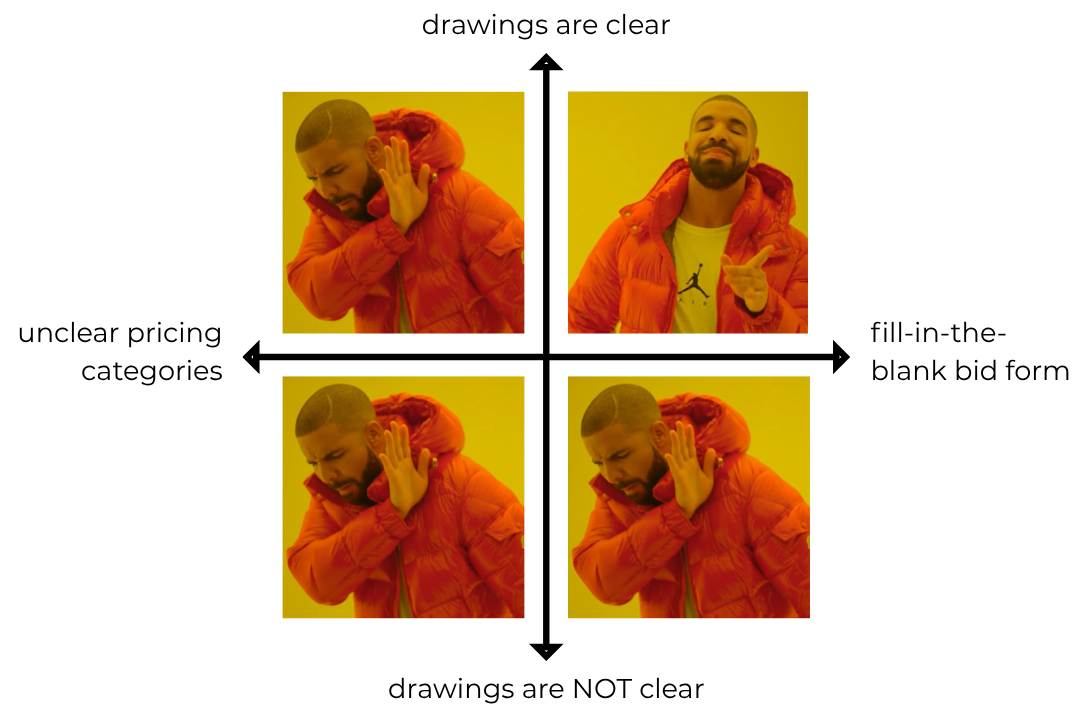
Well, what comes back is heavily dependent on what went out. It’s a boomerang that can either really benefit you or really hurt. How clear the drawings and specifications are is one variable. Whether you sent a fill-in-the-blank bid form or just asked for pricing in response is another. You can end up with any combination of the two, and the fuzzier the documents and the looser the ask, the more decisions each contractor is making (usually without telling you).
What Am I Buying, Exactly?
A bid should answer that question, and a lot of them don't. Some come back as nothing more than a lump sum value. Some come back with line items so vague they may as well be lump sums (”masonry” and “roofing”, I’m looking at you). You might know what it costs, but you don’t know what it is.
Take a line item like “roofing”. If you’ve got clear drawings and specifications, the extent of scope — what components you’re removing and what you’re providing — should be understood, but even still there are miscellaneous bits and pieces (“fringe” scope, if you will) that slip through the cracks simply by not having a good home. Roof-to-wall flashing is a prime example. Does the contractor carry it in the “roofing” line item? Is it carried as a part of roof accessories? Miscellaneous metals? Somewhere unassuming entirely? Different bidders putting this fringe scope in different buckets can make it impossible to compare anything but the bottom line number.
“General conditions” is another fun one. Does that include permits? Are safety measures included and, if so, what type? What about foreman oversight? If there is oversight, is the contractor pricing it as a dedicated individual or the same person laying the membrane? If the latter is the case, you’re either getting production or oversight at any given moment. Knowing the specifics helps to understand the risks you may be taking on with your purchase.
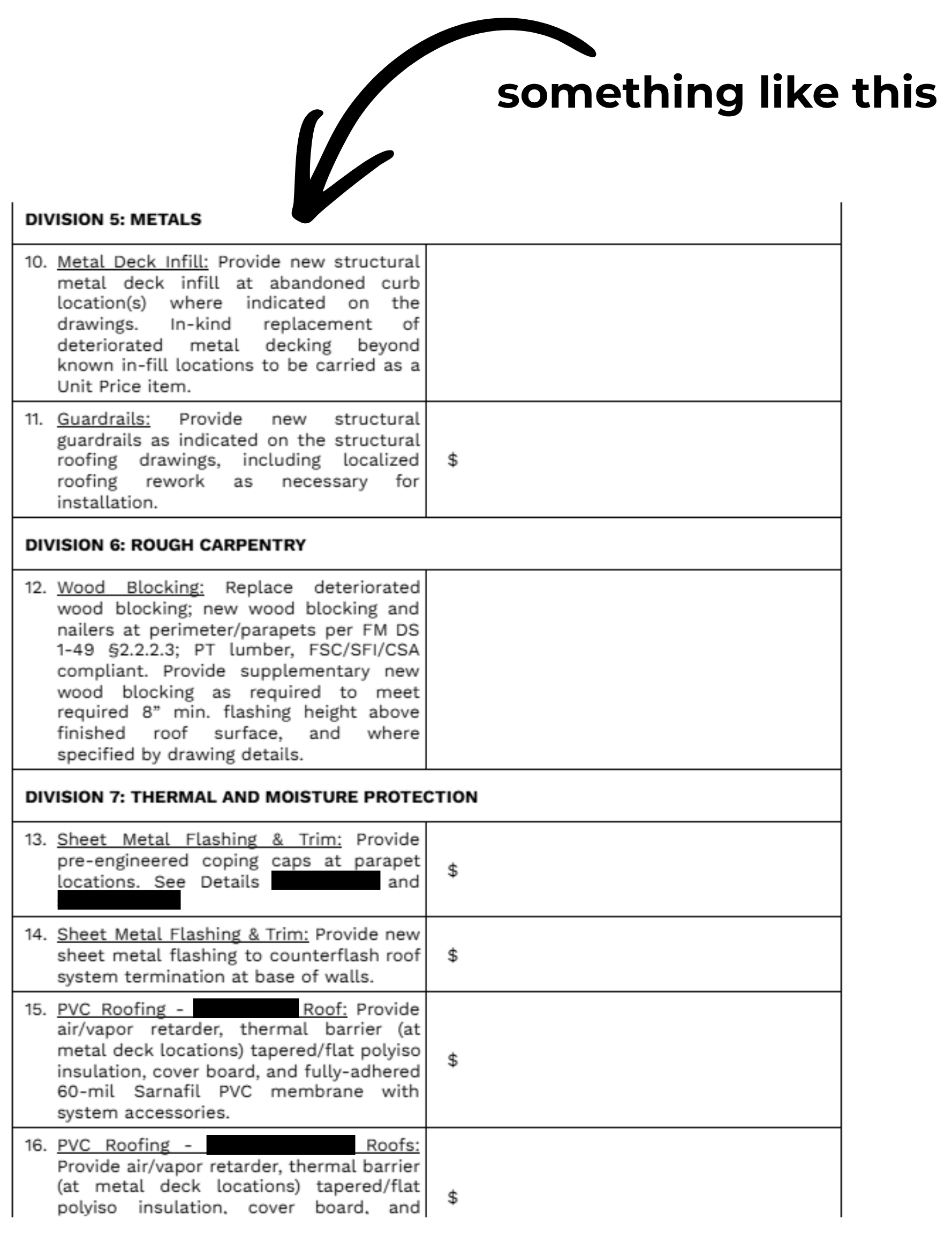
The good news is you’ve got a lot of power here. If the bid form comes from you, the scope can be broken out exactly the way you want to see it. Your team can provide a fill-in-the-blank bid form (read: idiot-proof) where every contractor is putting the same scope in the same buckets.
Silence ≠ Clarity
The way a contractor gets from unclear documents to a bid they can price is by asking. That’s what RFIs are for, and it’s why I sometimes sound like I’m gentle parenting when I’m begging them to use their words. When the bid period goes by without a single RFI, it’s tempting to take that as a compliment on the drawings that must be, by virtue of having no clarification requested, ✨ crystal clear ✨. Wrong (though I would love for that to be how it works). No questions usually means that when the contractor hit an unclear spot, they made an assumption, and kept pricing. It also means that you’ve now got several bids in front of you built on several different sets of assumptions.
You can’t force a contractor to ask a question, but what you can do is make them tell you what they assumed. In the standardized bid form, include a section called Assumptions and Exclusions and Dirty Little Secrets. Ok, kidding on the last part, but the first two hold true. Now the guesses are on paper instead of in somebody's head, and a guess you can see is one you can question or have the other bidders price the same way, before awarding.
Right-Sizing the Unknown
Surprises on an active construction site suck, which is why we build in a pretty little buffer called contingency. What that contingency value is, though, should depend on the project. How complex is the building? Is it new construction or existing? If the latter, how much does anybody know about how it was actually built? Is it a GC coordinating five subtrades or a single roofer covering the whole scope? Those answers should push the percentage up or down.
So when a contractor carries 10% on an old building with a lot of unknowns, they’re lying to themselves and, by extension, to you. We typically look for something in the 15-20% range as a starting point. From there, the number should adjust to scale with the project-specific complexity and unknowns and when it doesn’t…hello, gorilla.
Getting Oranges to Apples
Once you can spot the gorilla, you’re down to the oranges. With the standardized bid form, the bids are readable, the assumptions are on paper, and…the numbers still don't quite line up. But now you can see exactly where they don't. That's progress.
Two more things get you the rest of the way:
- Ask for unit prices and allowances. Specifically, do this in a standardized table in the bid form – much like you did with the base bid scope – so you get the same unit prices from all the bidders. Always include the labor rate for miscellaneous additional work and any material markup for miscellaneous additional work. For projects like roof replacements, also include common unknowns like deck repair or replacement.
- Hold a descope meeting. With the owner, and designer, and apparent low bidder or contractor you intend to award. The intent of this meeting is to double check that the design intent is what got priced and get any questions – ya know, the ones that weren't submitted as RFIs – answered before mobilization.
Do these two on top of the standardized bid form with stated assumptions and you’ve got a lunchbox packed with apples.
A Lunchbox of Apples
So, as it turns out, the unicorn apples to apples scenario doesn’t have to be rare at all – a fill-in-the-blank bid form, written assumptions and exclusions, pre-determined unit price categories, and a descope meeting before award can effectively capture the mystical and the magical. Your lunchbox of nothing but matching apples is served. Bon appétit!
When Apples Don’t Make Sense
Now, everything up to this point has assumed you're buying a thing…like a new roof. Using fill-in-the-blanks to get a whole bunch of indistinguishable apples works in these scenarios because a thing can be itemized.
Where you don’t want to make everyone fit into the same (lunch)box is when you’re buying an approach. This occurs when you’re hiring a consultant or a designer or someone who is going to somehow alleviate the pain of whyever you hired them.
“Um, but Carmen, didn’t you just preach for four whole minutes on how apples to apples is the unicorn situation to strive for?! Why don’t I want this for service-based pursuits?”
When you’re judging an approach and you try to fit everyone in the same box, you have to keep in mind that you are the one who drew the box, around a set of solutions you already know about (you just need others’ expertise to execute). But every so often someone shows up with an approach to answer to your problem that you didn’t even know existed, and so the box you drew can’t accommodate.
Perhaps you want to assess your portfolio of roofs. You may ask everyone interested to submit qualifications, resumes, approach, referrals, services, fee, etc. etc. etc.; nothing but professional binding and an ISBN short of full-fledged book. But if a consultant comes bearing a reimagined submission with interactive content that doesn’t just describe the approach, but actually demonstrates it (which is sort of the whole point of an approach, no?), what’s the value in forcing them back into the smaller box just so they can line up with the others? If somebody shows up with a solution the box wasn't built for, let that speak for itself.
All in all, when we strip away the fruit and zoo animals and mythical creatures (thank you for appeasing me), it becomes quite simple: know what you're buying, and let that decide how you go about buying it.