
Nobody goes into facilities or property management because they love asking for money, and yet a big chunk of your job comes down to walking into a meeting with the Big Bad Budget people and convincing them, as they clutch their purse strings, that a roof they’ve likely never stood on deserves a slice of the pie that everyone else is also fighting over. No pressure (you want to quit though, right?).
Matt and I recently attended the Tradeline Facilities Renovation and Repurposing Conference where we met and mingled with facilities managers and project managers alike from all over the country and spanning institutions from higher education campuses to hospitals to national labs to NASA (be still 7 year old me’s astronaut-wannabe heart). Did I go into this conference thinking I would spend most of my time commiserating with others in the industry over lack of funding? Yes, and for good measure, duh. Lack of funding came up, of course, but the bigger frustration and emotion that resurfaced in conversation after conversation was something different. You have the evidence for what needs to be done, but nobody “upstairs” can read it. If the money pie can’t grow, then the issue at hand is how to make the most compelling case to get the slice of pie you want.

Duolingo Did Not Prepare You For This
The pattern goes like this: you know a building needs work, and so you do the responsible thing and hire an expert to assess the existing conditions and hand over the evidence you’ll need to get the big bucks for your project. And then the findings come back, and they support what you’d suspected and the ask for money, but they’re written in Expert – aka the almost-dead language spoken only by those who got a four-to-six year degree in Building Science and Technology or Civil Engineering or Architectural Engineering or Materials Science or something that sounds like they spent a lot of time with their nose in a book of equations in college. So, congratulations, you’ve now found yourself in the role of translator because technical findings and budgeting inherently speak two different languages. And you must turn these technical findings into a business case, which was never in your job description and maybe would’ve kept you from applying if it was.

To the Big Bad Budget people clutching their purse strings, a perfectly accurate and reasonable technical finding about remaining service life can sound like the teacher in the Peanuts cartoon droning on. Wah wah wah, anticipated service life, wah wah, roof, wah. It’s not that they don’t care about the building, but nobody has told them why they should care about this one, today, more than everything else vying for the same dollars. What do the technical findings mean in the context of this specific building? How does its use inform the risk and sensitivity of projects? Is it a cutting-edge lab facility that protects research or super expensive equipment, or a maintenance slash junk drawer storage building? Is it a building deeply tied to the institution’s reputation with student or staff recruitment, or public-facing events? Answers to these may perk the ears of the higher-ups, but spinning the story into that is now up to you.
Le Phrasebook du Budget
If you’re already in the translator’s chair, take a deep breath. You’ve got this. A handful of good questions and some ballpark answers will get you most of the way to a business case.
Start with what the building protects
Begin with figuring out which bucket (or buckets) the building falls into, and then ask the related questions.
Laboratory or Medical Space
Think mission-critical or innovation spaces like research labs, operating rooms, or clinics.
- Are there spaces that require tightly controlled conditions, like temperature, humidity, or cleanliness?
- Is there sensitive and/or expensive equipment or spaces inside (e.g., imaging machines, isolation rooms, spectrometers and microscopes, etc.)
- Is there grant-funded or other reputable – potentially reputation-tied – research happening in the building?
- If the research gets interrupted, can it be paused or moved, or does it start over?
- Is the space used 24/7 (e.g. a vivarium that houses animals), or are there periods of full downtime?
Administrative Space
Basically, if it houses any desk job where you’re paying people to work there.
- How many people work here, and is there anywhere else to put them?
- How important are those people? Ok, we know they’re all important, but in the context of the hierarchy to the institution they’re serving. How serious would their complaints be if taken to The One Who Runs It All?
- Does anything the institution depends on for functionality live here, like IT, servers, or records?
- Do visitors, donors, or the public come through?
Academic, Event, or Residential Space
Think classrooms, residence halls, event spaces, or retail.
- How many people use it on a typical day?
- Does it bring in money, through tuition, patient care, housing, or rental?
- Is it on the tour for prospective students, staff, or donors?
- If it went offline, where would everyone go? What would the ripple effect be in terms of other buildings or services displaced?
Storage and Support Space
If it’s dust collecting on boxes or the closet door you don’t want to open because everything will fall out and nothing will fit back in…
- What is being stored in the space? Would anyone notice – or care – if it got wet or destroyed?
- Does it house equipment or utilities that service other buildings? If yes, what buildings and what would be the impact of that equipment or utility going down?
Figure out some rough numbers on what waiting could cost
- If this fails – let’s hypothetically say tomorrow – what goes offline, and for how long?
- What else gets damaged when it fails – are we talking just interior finishes in an empty building? Finishes + contents, where the contents are stored dorm mattresses that can be replaced? Finishes + contents, where the contents are millions of dollars of imaging equipment?
- How many work order or emergency (reactive) repairs has the building racked up in the last few years? Is it more, less, or the same as previous years? How much have these repairs cost you?
- Is there a good window for potential work, like summer break or a planned renovation, that would be missed by waiting longer?
- Is anything still under warranty?
- Does the current condition create a safety, code, or insurance issue if left alone?
Ballpark answers to even half of these will get further in a budget meeting than any service-life number.
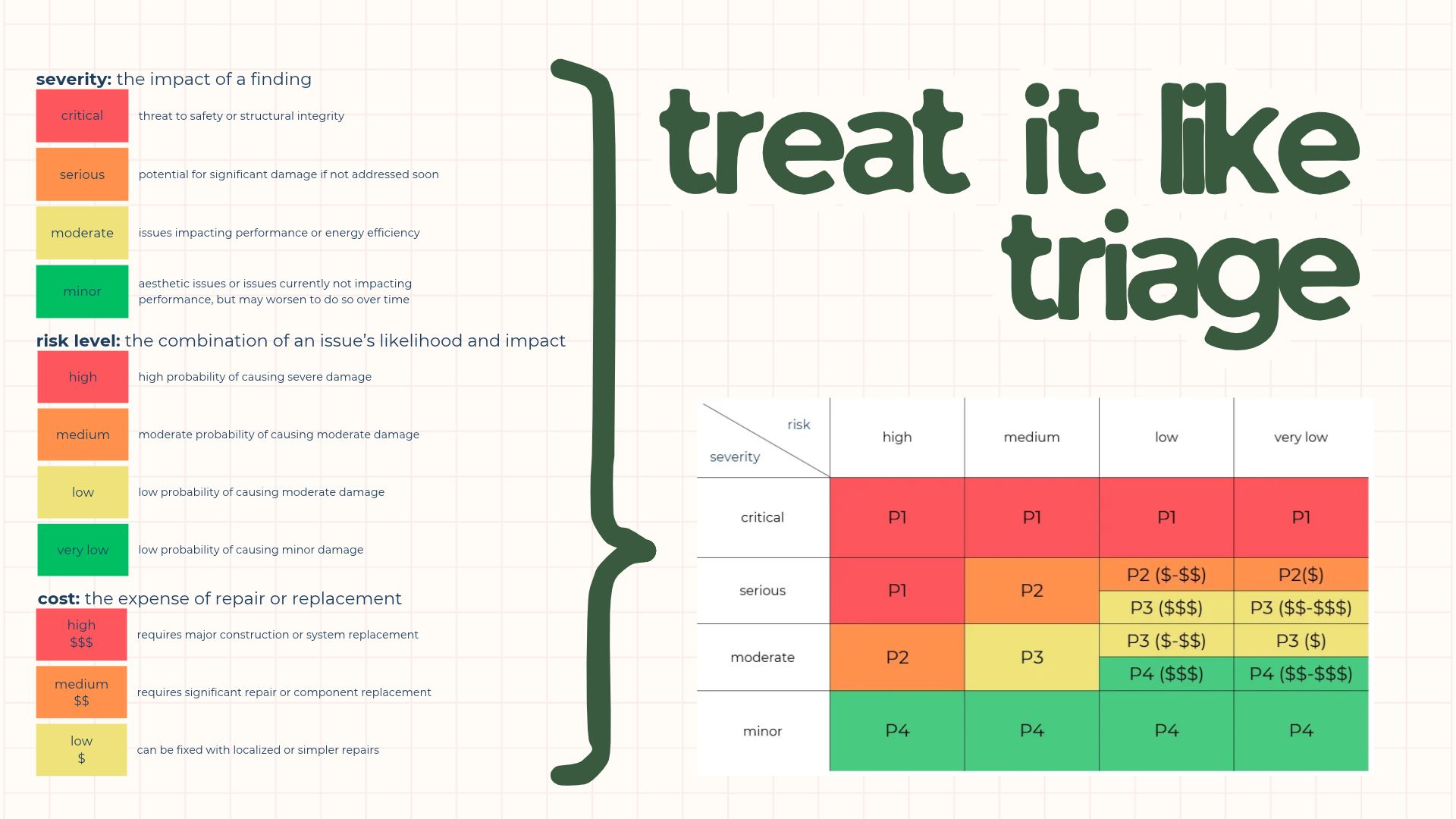
Look at a triage chart
Take your answers from part 1 and 2 – which basically give you risk and severity – and give them a priority based on a pretty color coded matrix like the one below.
Or skip all of the above and hire someone who’s already fluent
Ok, we may be a little biased here. We’ve gotten a bit obsessive over this exact problem so that technical findings come out ready for who’s eventually going to read them. Take a look at how we work.
Either way, bonne chance at the next budget meeting. May your slice of budget pie be a generous one.