
I want to say upfront that I have nothing against Microsoft Word personally. It got me through high school English class and has long been the default home of the engineering report for as long as anyone in this industry can remember. Back in the day, it even came with a little paperclip who wanted to help you write a letter (RIP Clippy, you were annoying and we loved you anyway). But it’s not 2004 anymore, and we’ve started to wonder why so much of the way we deliver information still acts like it is.
This isn’t a software rant, I promise. Word is still fine at being Word. The problem is what it does to the way we think about the deliverable, which is to say it decides the shape of the thing before we’ve even asked what the shape of the thing should be.
From Quill to Clippy…to Beyond
Think about how the tools for writing have turned over. Handwriting was the default for writing lengthy things like reports and novels and letters to loved ones at war for literally millennia. But then the pace of everything around it picked up and handwriting couldn’t keep up (and, with all the love in the world for my engineering friends, legibility was never our strong suit). Typewriters were faster and everyone could read them, so we evolved. And then word processors came along and you could fix a typo without reaching for the white-out or retyping the whole page, and typewriters went to live in antique shops and on decor-laden bookshelves at very specifically-curated coffee shops…or the bookshelf in Matt Copeland’s office.
None of these tools failed exactly. Handwriting still works. Typewriters still work. They got outpaced by the speed of the world around them.
Word processors are now having their moment. It’s still perfectly capable of writing a report, but it’s also very early-2000s and the rest of our tools have moved on without it. A written report reads front to back, and buildings don’t. A technical finding is visual and spatial before anything else, and we end up condensing that into 2D words on a page. Sure, we have photos, and we probably talk about specific locations or maybe even mark it up on an elevation in the report, but even so, those traditionally live on different pages. Which means you, the reader, end up stitching together those pieces with three fingers wedged in the report binder. It’s doable (we’ve all done it), but the format has pigeonholed us from getting more out of it in a convenient fashion.
Think Different
Other industries figured this out a long time ago. Apple ran an entire campaign on “Think Different”, rallying creatives and innovative minds to consume their brand. Volkswagen told us to “Think Small”, effectively selling a little round Beetle to a country that was very into big cars. Neither of those pitches were about a feature; they were about giving people permission to stop doing something just because it was the default.
The AEC industry could use a little of that energy. We can build things that last, and apparently that has also included our habits. “The way it’s always been done” has had a long run, and we’re here to (gently) dethrone it.
We Can Be Obsessive
We’re Big Thinkers over here at CopelandBEC. Deep reflection and introspection and throwing out a million half baked ideas until we get our lightbulb moment (and then starting again). We’ve mapped industry processes and our own processes end to end, critically evaluating where value is being added, what the industry pain points are, what our own pain points are, how all of these overlap and intertwine and relate.
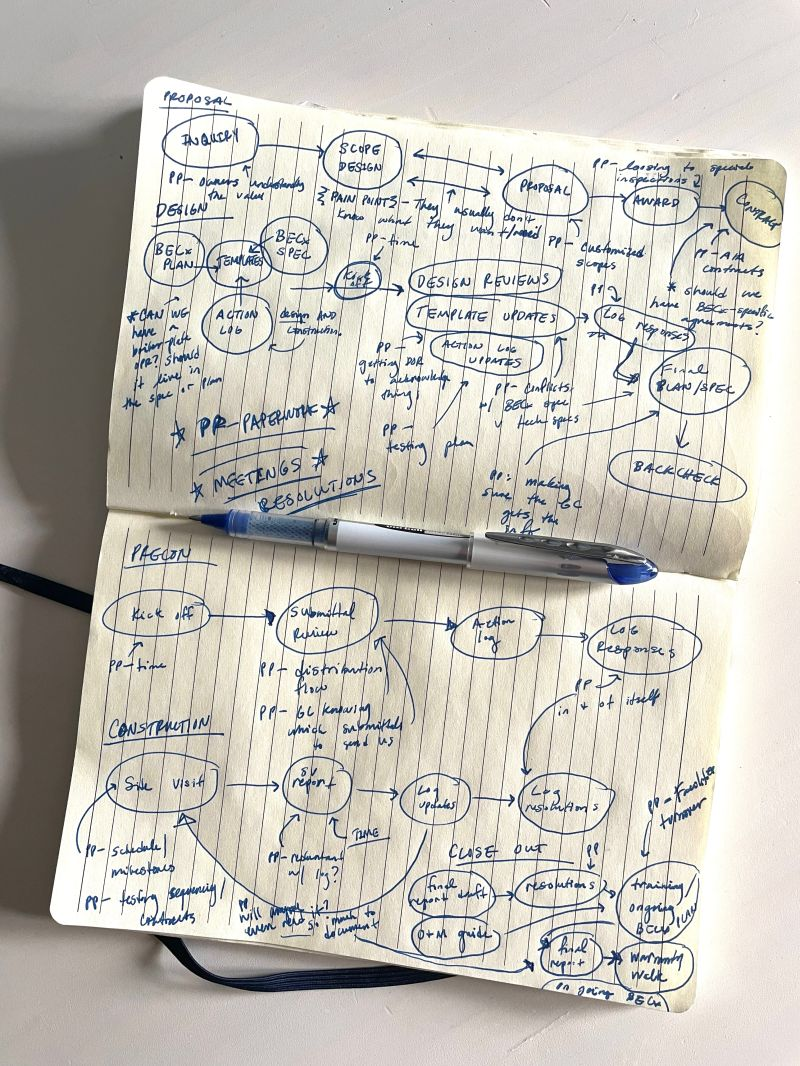
A process map drawn by our Director of Commissioning (which at first glance also looks close to her toddler’s notebook scribbles)
“That’s the way it’s always been done” or some variation of that statement are, without exaggeration, some of our least favorite words to hear. Groan, sigh, eye roll. Historically speaking, construction is slow to evolve compared to other industries. The automotive industry has significantly increased productivity in the last century, cutting labor hours per car by ~60% and increasing worker output by nearly 10x from 1931 to 2013, all while increasing the complexity of cars from 5,000 mechanical parts to around 30,000, plus adding software integration. Sectors like tech and AI are evolving rapidly by the day, by the hour, by the minute. Meanwhile construction practices have largely been doing things the same way for my entire life and decades before that, with the occasional daring leap from a French Vanilla to Vanilla Bean. We actually move slower today than we did a century ago. In 1931, we constructed the 130 floor climbing gym of King Kong (also known as the Empire State Building) in 15 months. And over 80 years later, with vast improvements in safety and conveying systems and BIM models and worker training and yada yada yada, we constructed the 104 floors that make up the One World Trade Center. In 75 months. Comparing across industries, our trajectory chalks up to taking 5x longer to build something today than it did in 1931, while others are moving almost 2,000x faster.
Why Can’t We?
We’d like to evolve faster than that, if for no other reason than to stop putting up with what’s no longer serving us in this day and age. Our favorite question is some version of "well, why couldn't we do it this way?", followed closely by going and trying it. Some things in this industry take their time for good reason (we love buildings that outlast us), but the way we hand over information about them doesn’t need to be one of them.