
BERDO is a city ordinance in Boston. BERDO’s goal is to improve the performance of large existing buildings.
In 2013, the City of Boston enacted the Building Emissions Reduction and Disclosure Ordinance (BERDO), which required all commercial and residential buildings with 35,000 square feet or 35+ units to report their water and energy usage.
BERDO 2.0 came along in 2021 and builds on the first ordinance to not only require annual reporting, but also mandate performance requirements to drive decarbonization.
BERDO Buildings
Boston’s BERDO 2.0 applies to:
- non-residential buildings exceeding 20,000 square feet*
- residential buildings with 15+ units
- any parcel of land with multiple buildings that collectively add up to 20,000 square feet or 15 units
- buildings owned by the City of Boston and Boston Housing Authority
*Beginning in 2023, buildings between 20,000-35,000 square feet must report their energy use. These buildings are not required to comply with the emissions standards until 2030, and must begin reporting in 2031.
The City of Boston has assembled a list of all properties qualifying for BERDO for 2023.
BERDO Compliance Requirements
To comply with BERDO 2.0, a building must satisfy 3 criteria: (1) reducing emissions, (2) reporting the total building energy and water use, and (3) third-party verifying reported data.
Emissions Requirements
BERDO requires that buildings reduce emissions below the standards set, and requirements are based on the building use and year. The goal is for all buildings to reach net-zero emissions by 2050.
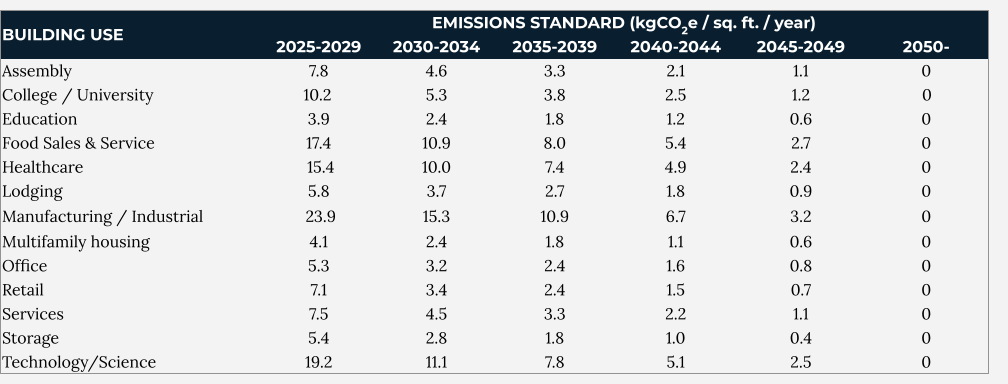
BERDO 2.0 offers several pathways to achieve compliance with the emissions standards.
The first approach is to directly reduce emissions through building improvements such as increasing insulation, tightening window seals, or upgrading to high-efficiency appliances and HVAC systems.
The second pathway involves locally generating renewable energy, such as rooftop or community solar, or purchasing eligible renewable energy in the market.
“Alternative Compliance Payments” is the third option. It allows building owners to pay a fee for exceeding the emissions standards set. The current price is $234 per metric ton of CO2e emitted. The BERDO Review Board and Environment Department is responsible for re-evaluating the cost every 5 years.
Reporting Requirements
Building owners must report the total energy and water use of their buildings for the prior calendar year. Reports are due to the City of Boston by May 15th each year and must include the following information:
- basic property information (address, building use, square footage, etc.)
- energy and use
- a list of all energy utilities that have served the building in the past calendar year
- fuel delivery bills for the entire past calendar year
- the number of meters serving the building
- if the building has any Renewable Energy Certificates (RECs)
- if the building has any Power Purchase Agreements (PPAs)
- use of unique emissions factors
- contact information for the building owner/management company
BERDO uses the EnergyStar Portfolio Manager to input and manage reporting information. Use the BERDO Reporting Form to submit information not collected on the EnergyStar platform. For more information on how to report, read the BERDO 2.0 Reporting How-To Guide.
Third Party Verification
After the first year of reporting to BERDO and every subsequent 5 years, building owners must third-party verify their reported data.
Third-party verifiers include Professional Engineers (PE), licensed architects, Certified Energy Managers (CEM), or similar credentialed parties that are not affiliated with the building owner or property management organization. A full list of acceptable third-party verifiers can be found in the BERDO 2.0 Reporting How-To Guide.
The intent of this process is to review the data for any inconsistencies and help building owners to adequately prepare for the emissions standards that are fast-approaching.
Non-Compliance Consequences
Failure to comply with any of the 3 compliance requirements (emissions, reporting, and third party verification) can result in significant financial penalties.
| Infraction | Penalty |
| Failure to meet emissions standards | Daily fine of $300-$1,000* |
| Failure to meet reporting requirements | Daily fine of $150-$300* |
| Discrepancies in reported data found by a third-party verifier are not reconciled | $1,000-$5,000* |
Boston BERDO Consulting Services
2025 is around the corner and, even for properties that meet the current 2025 carbon limits, increasingly aggressive decarbonization requirements will be quick to follow.
This makes it increasingly important for building owners and property managers to have an understanding of their building’s performance so that they can develop a plan to meet the upcoming emissions standards.
Not only will this help owners to avoid the steep financial penalties of non-compliance, but addressing the problem today presents an opportunity to address any long-standing building envelope issues which can improve your building’s comfort, performance, and increase its overall value—with the benefits compounding over time.
We’re here to help you each step of the way!
When considering building improvements to reduce energy use, CopelandBEC has a team skilled in building envelope condition assessments which can help determine the best options for long-term infrastructure and energy improvements. We can pair these assessments with detailed building science computational analysis and modeling.
We also have long track record working with historic buildings, including designing mass masonry insulation programs. Our experience allows us to maintain a balance between modernization to cut energy usage and retaining the historic character of the original building.
CopelandBEC has several Professional Engineers on staff that are qualified to perform BERDO third-party verification for self-reporting properties.
Love learning about making buildings work better? Sign up to get our updates sent to your inbox. No spam, cancel anytime.
Talk to a building envelope consultant
We help owners, design teams, and attorneys think through roofing, commissioning, and litigation questions. Tell us about your project and we’ll point you in the right direction.
Schedule a consultation